


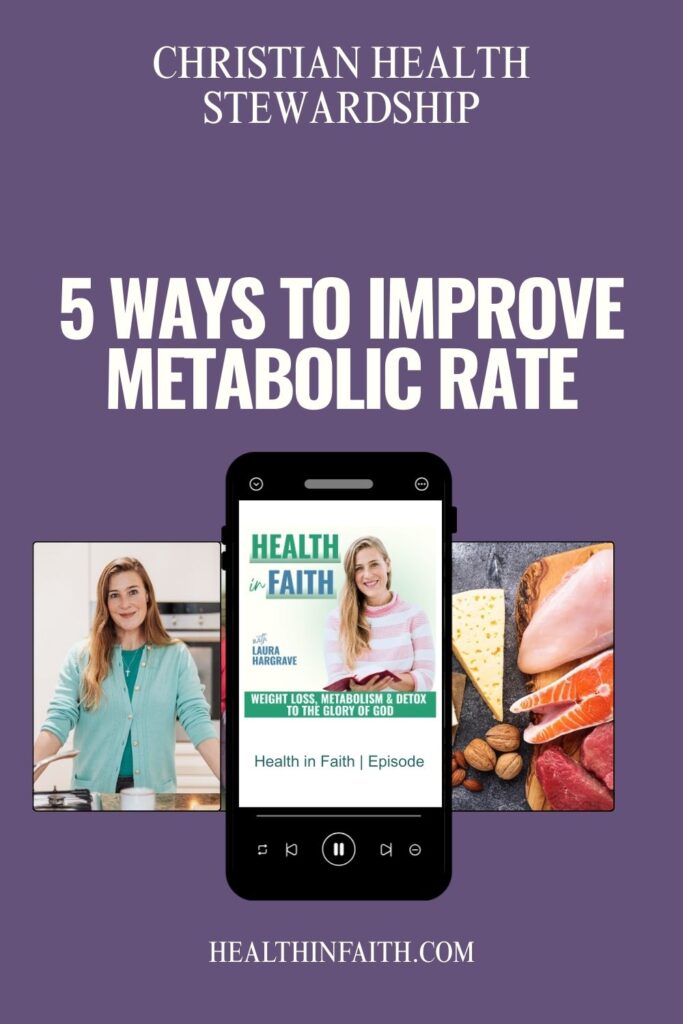
Ep 20 | 5 Ways to Improve Your Metabolic Rate & Flexibility


Many Christian women feel as though their metabolism has “given up on them.” They’re eating clean, choosing healthy foods, avoiding sugar where they can, and still feel tired, snacky, and stuck. Energy dips mid-morning or mid-afternoon. Hunger feels urgent instead of gentle. And over time, this begins to affect not just the body, but patience, focus, mood, and spiritual stamina too.
What’s often missing from the conversation is metabolic rate and flexibility. Metabolic rate is the amount of energy your body uses to perform basic functions, such as breathing and digestion, as well as during physical activity. Metabolic flexibility is your body’s God-designed ability to switch between burning carbohydrates and fat for fuel depending on availability and need. When this system is working well, energy is steady, hunger signals are clear, and the body feels resilient. When it’s impaired, the body becomes dependent on frequent glucose intake, leading to cravings, fatigue, and a constant sense of needing to eat.
This isn’t a discipline problem. It’s not a lack of willpower. It’s physiology.
Scripture reminds us in Proverbs 3:7–8 that wisdom brings “health to your body and nourishment to your bones.” God cares about how His design functions, not just our intentions. Supporting metabolic health is an act of stewardship, not self-indulgence.
One of the biggest metabolic mistakes many women make is constant snacking – especially in sugary things. Grazing throughout the day keeps insulin elevated, which blocks fat-burning and trains the body to expect a constant supply of sugar. Over time, this reduces metabolic rate and flexibility. The body never learns to access stored fuel because it’s never given the opportunity.
Biblically, this aligns with the concept of intentional meals rather than constant consumption. Eating with rhythm allows the body to rest between meals, reset hunger hormones, and re-learn how to burn fat efficiently. This doesn’t mean ignoring hunger or restricting food. It means eating enough at meals so you don’t need to snack constantly in between.
Improve Your Metabolic Rate with Intermittent Fasting
Another powerful tool for restoring metabolic rate and flexibility is gentle intermittent fasting. This phrase often triggers fear, but intermittent fasting simply means extending the natural overnight fast. There is a world of difference between fasting and starvation. Fasting is structured, nourishing, and purposeful. Starvation is chaotic, stressful, and depleting.
Research shows that even modest fasting windows improve insulin sensitivity and metabolic efficiency by allowing insulin levels to fall and fat-burning pathways to activate. For many women, a simple 12–14 hour overnight fast is enough to begin restoring metabolic balance. From a faith perspective, fasting has always been a practice of clarity and dependence on God, not punishment of the body. When done gently, it supports both physical and spiritual renewal.
Movement
Movement timing also plays a surprisingly large role in metabolic health. Fasted morning walking is one of the most overlooked metabolic tools available. Low-intensity walking in a fasted state teaches the body to access fat for fuel without spiking cortisol or stressing the nervous system. This is not about burning calories. It’s about training fuel usage.
Post-meal walking is equally powerful. A short walk after eating significantly lowers postprandial blood sugar and improves insulin sensitivity by encouraging muscles to absorb glucose without requiring large insulin responses. Studies consistently show that postprandial movement improves metabolic markers more effectively than intense workouts performed at other times.
Walking is deeply biblical in nature. It’s accessible, gentle, and consistent. Humans were designed to move daily, not sporadically or violently. When we walk, we align with how God designed our bodies to function.
Fat’s Your Friend for Your Metabolic Health & Hormone Balance
Dietary fat is another area where fear has harmed metabolic health. For decades, women were taught to fear fat, yet fat plays a crucial role in satiety, hormone production, and metabolic rate. Adequate fat intake reduces hunger, stabilises blood sugar, and helps the body shift away from constant glucose dependence.
This is especially important for women over 40, whose hormonal landscape changes and whose bodies often require more stable fuel sources. Healthy fats from whole foods were created by God to nourish, not harm. The real metabolic issue is not fat, but the combination of ultra-processed carbohydrates and constant eating.
Lowering carbohydrate load is often necessary to restore metabolic flexibility, but this does not mean eliminating carbohydrates entirely. High-carb diets that rely on refined grains and sugars overwhelm blood sugar regulation. Medium-carb, whole-food carbohydrate sources allow nourishment without spikes.
Keto Diet
Keto can be a useful short-term tool for metabolic repair, particularly for those with insulin resistance or severe metabolic dysfunction. However, keto is a strategy, not an identity. It does not need to be permanent to be effective. Discernment matters more than dogma.
From a biblical perspective, wisdom is about right application, not rigid rules. The Keto diet done in the right way, like my Keto Life programme for Christians, is completely freeing, not restrictive. Ecclesiastes reminds us that there is a time and season for everything. Metabolic healing follows the same principle.
When metabolic flexibility improves, something beautiful happens. Cravings quiet. Energy steadies. Food stops dominating thoughts. And spiritual practices feel less draining. Patience becomes more accessible. Focus improves. Self-control no longer feels like white-knuckling through temptation, but cooperating with a body that is no longer in survival mode.
Romans 12:1 calls us to present our bodies as living sacrifices. This does not mean exhaustion or deprivation. It means alignment. Supporting metabolism allows the body to serve the spirit instead of fighting against it.
Scientific research strongly supports this integrated approach. Studies have shown that impaired metabolic flexibility is associated with insulin resistance, obesity, and fatigue, while restoring it improves energy utilisation and metabolic efficiency. Research published in the American Journal of Clinical Nutrition highlights how insulin sensitivity improves with fasting and reduced meal frequency. Work in the Journal of Applied Physiology shows that fasted exercise enhances fat oxidation. Research in Diabetologia demonstrates the powerful effect of post-meal walking on blood sugar control.
God’s design is not broken. It’s often just overwhelmed.
If you’ve felt frustrated with your body, tired of feeling snack-dependent, or guilty for struggling with energy and self-control, this is your invitation to release shame. Healing doesn’t come from pushing harder. It comes from supporting what God already designed.
Start small. Choose one habit. Stop snacking between meals. Walk after dinner. Extend your overnight fast gently. Increase healthy fats. Lower carbohydrate load with wisdom. Metabolic health is restored through consistency, not extremes.
And when the body is supported, obedience becomes lighter. Energy returns. Peace increases. And your Christian walk is strengthened from the inside out.
Scientific references
- Kelley DE et al. Metabolic flexibility and insulin resistance. Current Opinion in Endocrinology, Diabetes and Obesity
- Mattson MP et al. Impact of intermittent fasting on health and disease processes. Proceedings of the National Academy of Sciences
- Ludwig DS et al. Dietary carbohydrate restriction and metabolic health. JAMA
- DiPietro L et al. Walking after meals improves glycemic control. Diabetologia
- Galgan RJ et al. Insulin resistance and appetite regulation. American Journal of Clinical Nutrition
Next Steps – Work with Me to Improve Your Metabolic Health
📌 Special Offer: Book your 60-Minute Nutritional Metabolic Breakthrough Consultation for personalised support → www.healthinfaith.com/breakthrough
Leave a Reply
I'm so glad you're here
For health tips, inspiration & insights - to equip you to thrive in our uncertain times- follow me on Insta @lauranutritionist


TUNE IN NOW
Health in Faith Podcast has now launched!