


Ep 24 | From Sugar Crashes to Strength – The High Protein Breakfast God Designed
Many of the women I work with tell me that a lot of their mornings feel like a spiritual and physical uphill climb…maybe you can relate? If we start the day tired, hungry, foggy, or already thinking about our next cup of coffee or snack — it’s tempting to then quietly blame ourselves for lacking discipline. But this is rarely a motivation issue. More often, it’s an issue of how we fuel our body.
How you break your overnight fast sends powerful signals to your hormones, brain, metabolism, and even your emotional resilience. Breakfast doesn’t just ‘start your day’ — it really does set the tone for hunger and appetite, cravings, energy, focus, and blood sugar regulation for hours to come. It’s no joke and we ought to take that seriously. In Episode 23 of Health in Faith we look at some of the powerful things a high protein breakfast will do for you.
A high protein breakfast isn’t a modern diet trend. It’s deeply aligned with how God designed the body to function and it’s also beautifully reflected in Scripture when we slow down enough to notice it.
What you ‘break your fast’ with matters
When you wake up in the morning, your body has been fasting for anywhere between 8–16 hours or more. During that time, blood sugar gradually drops, cortisol rises to help you wake up, and your brain is primed to look for fuel. What you eat first tells your body whether it needs to stay in ‘stress mode’ or whether it’s safe to shift into stability and strength.
A breakfast dominated by sugar or refined carbohydrates — cereal, toast, porridge, pastries, fruit juice, even smoothies without protein — creates a rapid rise in blood glucose followed by an equally rapid crash. That crash triggers hunger hormones, cravings, irritability, fatigue, and a reliance on caffeine or snacks to get through the morning. Over time, this pattern contributes to insulin resistance, metabolic slowdown, weight gain, and poor energy regulation.
And over time, if not put in check…Insulin resistance and metabolic syndrome. Eek.
Thankfully, protein changes that entire picture.
Research consistently shows that higher-protein breakfasts improve satiety, reduce hunger hormones like ghrelin, stabilise blood sugar, and reduce overall calorie intake across the day. One well-known study published in The American Journal of Clinical Nutrition found that eating 25–30g of protein at breakfast significantly reduced cravings and snacking later in the day compared to lower-protein meals.
Read that again. 👆
In other words, protein helps your body feel safe, steady, and nourished — not desperate for the next hit of energy.
Jesus Cooked Breakfast — And That’s Not Accidental
One of the most tender and overlooked moments in Scripture happens after the resurrection. In John 21, the disciples have been fishing all night. They’re tired. They’re hungry. They’re discouraged. And what does Jesus do when He appears to them on the shore?
He cooks them breakfast.
“Jesus said to them, ‘Come and eat breakfast.’ Yet none of the disciples dared ask Him, ‘Who are You?’—knowing that it was the Lord. Jesus then came and took the bread and gave it to them, and likewise the fish.” (John 21:12–13, NKJV)
This wasn’t a sermon. It wasn’t a rebuke. It wasn’t a productivity talk.
It was fellowship – and protein.
Fish — a complete protein rich in amino acids, minerals, and fats — prepared and offered by Christ Himself before He addressed Peter’s calling, leadership, or restoration. Jesus met physical hunger before spiritual instruction. He strengthened bodies before commissioning hearts.
That’s not a coincidence. That’s the Lord’s wisdom and design.
Protein and the Way God Designed Your Metabolism
Protein is not just ‘for muscle’, ‘gym bros’ or ‘for weight loss’. It plays a an absolutely foundational role in nearly every metabolic process in the body.
Protein provides amino acids, which are required to build neurotransmitters like dopamine and serotonin, hormones like insulin and glucagon, enzymes for digestion and detoxification, and structural components for muscles, bones, skin, hair, and immune cells.
From a metabolic standpoint, protein also has the highest thermic effect of food (TEF). That means your body burns more calories digesting protein than it does digesting carbohydrates or fats. Studies show that protein digestion can increase metabolic rate by up to 20–30%, compared to 5–10% for carbs and 0–3% for fats. Er, that’s worth considering if you have any desire at all to shed excess belly fat!
Protein also slows gastric emptying, meaning it keeps food in your stomach longer and stabilises blood sugar release into the bloodstream. This is why people who eat adequate protein at breakfast often report fewer cravings, steadier energy, and better focus throughout the day.
As I type this, I’m sat at my desk with a stomach comfortably full from a high protein lunch I had hours ago. It’s mid-afternoon and for many years when I was not bothered about how much protein I ate, this is the time I’d be reaching for snacks and treats. Not now, praise the Lord.
This aligns beautifully with Proverbs 24:3–4:
“Through wisdom a house is built, and by understanding it is established; by knowledge the rooms are filled with all precious and pleasant riches.”
Wisdom builds foundations. Protein does exactly that for your body and your day.
What a ‘High Protein Breakfast’ Actually Means
For most women, a high protein breakfast means at least 25–40 grams of protein, depending on body size, activity level, and metabolic health. That’s far more than most breakfasts provide — and it’s why so many people feel hungry again by 10am.
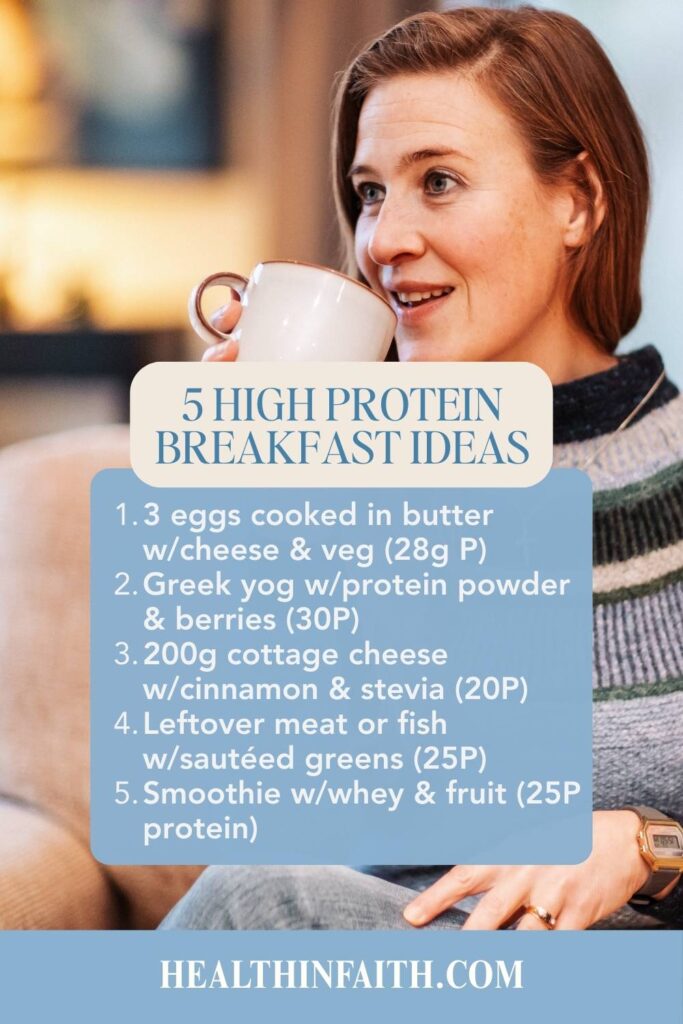
Here are examples of breakfasts that align with God’s design for strength and stability:
- 3 eggs cooked in butter or olive oil with cheese and vegetables (approx 28g protein)
- Greek yogurt or skyr with vanilla protein powder and berries (approx 30g protein)
- 200g cottage cheese with cinnamon and a dash of stevia…one of my faves throughout the day! (Approx 20g protein)
- Leftover meat or fish with sautéed greens – also one of my faves. Honestly, I’m often found eating chicken, cauli and Brussels sprouts for breakfast, with a delicious coriander yoghurt sauce I make, I love it! 🤣 (Approx 25g protein)
- A protein-rich smoothie made with whey, bone broth powder, plant protein or collagen; not just fruit (approx 25g protein)
Notice how these meals are simple, whole, and nourishing. They aren’t flashy but they’re functional. And they actually taste great, truly satisfy you and they respect your body’s need for real fuel.
Protein, Blood Sugar, and Self-Control
One of the fruits of the Spirit is self-control (Galatians 5:22–23). But self-control isn’t just a spiritual issue — it’s a physiological one too.
When blood sugar swings wildly, the brain shifts into survival mode. Decision-making weakens. Cravings intensify. Emotional regulation becomes harder. That doesn’t mean you’re failing spiritually. It means your nervous system is under stress.
Stable blood sugar supports calmness, focus, patience, and discernment. A high protein breakfast is one of the simplest ways to support that stability.
This is why Romans 12:1 speaks not just of belief, but of embodiment:
“I beseech you therefore, brethren, by the mercies of God, that you present your bodies a living sacrifice, holy, acceptable to God, which is your reasonable service.”
Fueling your body well is not vanity, it’s basic good stewardship.
Why This Matters for Christian Women
Many Christian women are serving everyone else before themselves — families, churches, communities — while running on fumes. Skipping breakfast or eating inadequately isn’t spiritual discipline. It’s often silent depletion.
When you nourish your body properly in the morning, you show up differently. You pray with clarity. You respond with patience. You work with endurance. You serve from fullness rather than exhaustion.
A high protein breakfast isn’t about dieting. It’s about capacity — the capacity to live out your calling with strength and joy.
One Simple Action Step
Tomorrow morning, ask yourself one question before you eat:
“Where is the protein?”
Build your breakfast around it first, then add carbohydrates and fats intentionally. This one shift can transform your energy, focus, mood, and metabolic health within days.
Small obedience in the physical often unlocks greater faithfulness everywhere else. Prioritising protein at breakfast is one such small but mighty act.
Final Encouragement
God cares about your mornings. He cares about your hunger. He cares about how you feel when you wake up and how you sustain the work He’s called you to do.
From the Garden, to the wilderness manna, to Jesus cooking fish on the shore — Scripture shows us again and again that God provides real food for real strength.
You don’t need sugar highs and lows to serve Him well.
You need steady fuel.
You need wisdom.
You need breakfast — the way God designed it. With a good amount of protein! Go to it.
Scientific References
Leidy HJ et al. “The role of protein in weight loss and maintenance.” The American Journal of Clinical Nutrition, 2015.
Jakubowicz D et al. “High protein breakfast prevents body fat gain and reduces cravings.” Obesity, 2013.
Westerterp KR. “Diet induced thermogenesis.” Nutrition & Metabolism, 2004.
Layman DK. “Dietary protein and exercise have additive effects on body composition.” Journal of Nutrition, 2005.
Links & Resources Mentioned
- Free Sugar Detox in Faith Plan: www.healthinfaith.com/sugardetox
- Book a 1:1 Nutritional Metabolic Breakthrough Consultation: www.healthinfaith.com/breakthrough
- Related Episode: Ep 18 | 5 Biblical Principles for Christian Healthy Eating


TUNE IN NOW
Listen to the Health in Faith Podcast