


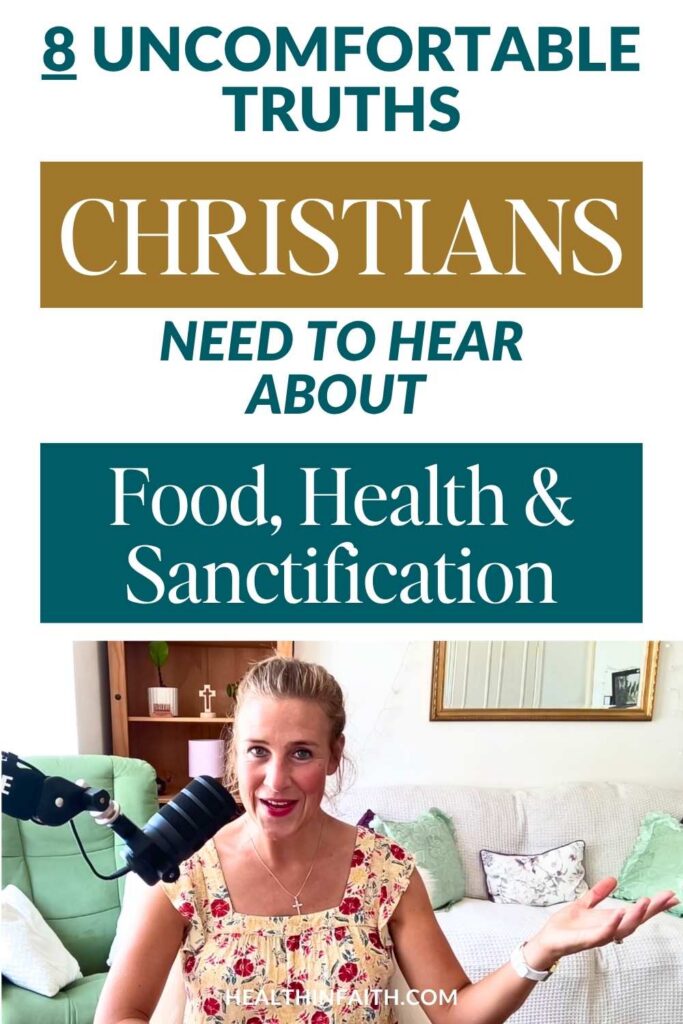
56 | 8 Uncomfortable Truths Christians Need to Hear About Food, Health & Sanctification
Christian health sanctification is a conversation we rarely hear in church, yet the way we eat, care for our bodies and respond to our physical health can affect almost every area of our lives. We talk readily about prayer, sexual purity, alcohol, stewardship, service and spiritual discipline, but food—something we engage with several times every single day—often remains strangely outside the conversation.
I believe that needs to change.
Join Eating to the Glory my 3-masterclass training to discover how to eat the way God designed — to effortlessly lose weight & restore your energy to fuel your God-given purpose
Our bodies are not irrelevant containers that we will one day discard. They carry our calling here on earth. They give us the physical ability to pray, serve, work, raise children and grandchildren, travel, evangelise, teach, write, worship and fulfil the assignments God has placed before us. Christian health sanctification is not about worshipping the body or making thinness a sign of holiness; it is about recognising that our physical lives belong under the lordship of Christ too.
Some of what follows may feel uncomfortable. That is intentional. These are areas I have personally wrestled with, been convicted about and had to change in my own life. My aim is not condemnation, but greater wisdom, discernment and freedom.
1. Food and Health Are Rarely Preached About — Yet They Affect Us Every Day
When was the last time you heard a sermon about how Christians eat?
We regularly hear teaching about sexual purity, drunkenness, drugs, money, relationships and guarding our minds. Yet food and health, despite affecting every Christian every single day, are rarely addressed with the same seriousness.
We eat three times a day, sometimes more. We make decisions about snacks, portions, ingredients, medications, exercise, sleep and medical treatment constantly. Our health influences our energy, concentration, emotional resilience and ability to serve. Yet we can spend decades in church without ever hearing a thoughtful biblical conversation about how to steward this area.
Scripture presents us as whole people. We are not disembodied spirits temporarily trapped inside meaningless flesh. The Christian hope is bodily resurrection. Jesus Himself rose bodily, and our future hope is not that we escape physical existence but that creation—including our bodies—is ultimately renewed.
That gives our physical lives significance now.
Christian health sanctification therefore deserves to become part of the discipleship conversation. Not because everyone needs to follow one perfect diet, but because food, appetite and health are areas in which wisdom, self-control and stewardship matter.
2. Christians Need Greater Discernment About the Modern Food System
The second uncomfortable truth is that we cannot assume every product labelled “food” nourishes the body equally well.
The food environment has changed enormously over the past several generations. The bread eaten in biblical times, for example, bears little resemblance to many mass-produced loaves available today. Traditional breads were generally made from a small number of ingredients and often involved long fermentation. Modern packaged bread may contain far more ingredients and undergo very different processing.
This matters because we sometimes use biblical language about food without considering whether the modern product is actually equivalent to the food being discussed in Scripture.
I often hear, “But bread is biblical.”
Yes, bread is biblical. But that does not automatically make every modern product carrying the word bread nutritionally equivalent to what people ate thousands of years ago.
The broader principle is discernment.
We should not become frightened or obsessive about food, nor do we need to research every ingredient as though our salvation depends upon it. But neither should Christians assume that anything sold in a supermarket must be healthy simply because it is legal, convenient or heavily advertised.
Give thanks for your food, absolutely. Then steward what you buy with wisdom.
3. Many Health Problems Have a Metabolic Component
One of the themes I have returned to repeatedly throughout the Health in Faith podcast is metabolic health.
After almost 25 years working in nutrition and health coaching, including earlier work within NHS medical research, I have seen how profoundly eating patterns and lifestyle can affect energy, weight, blood sugar, inflammation and general wellbeing.
We often default quickly to explanations such as age, genes or hormones. Women in particular are frequently told that weight gain, low energy or other symptoms are simply due to perimenopause, menopause or getting older.
Hormonal changes are real and can absolutely influence health. Genetics matter too. But neither should become an automatic explanation that causes us to overlook the areas we can influence.
I have worked with many women at different stages of life who have improved their energy, weight and metabolic health after changing how they eat and live. The lesson is not that food cures everything, but that our everyday choices can have far greater impact than we sometimes realise.
Christian health sanctification includes recognising the difference between what is outside our control and what God has genuinely placed within our stewardship.
4. The Rules Have Changed Over the Past 100 Years
We cannot necessarily eat in exactly the same way our grandparents did because our food environment is not exactly the same.
Agriculture has changed. Food manufacturing has changed. Supermarkets have changed. The availability of highly processed convenience foods has exploded, while many people have become disconnected from where their food comes from and how it is produced.
Animal husbandry is one example. I was vegan for seven years, and one of the strongest arguments within veganism is the appalling treatment of animals in some intensive farming systems. I still believe that concern deserves to be taken seriously.
My conclusion now, however, is not that all Christians therefore need to become vegan. Scripture does not teach that. Rather, it should make us think seriously about stewardship.
If animals are raised for food, how are they treated? What are they fed? What kind of conditions do they live in? What kind of farming system are our food choices supporting?
I now try to eat very simply. Where practical, I choose higher-quality whole foods, organic produce when available, good-quality eggs, dairy and fish, rather than filling my trolley with products from every supermarket aisle.
It does not have to become complicated or extremely expensive.
The principle is simple: the modern food environment requires more intentionality than it once did.
5. A Little Nutrition Knowledge Can Be Dangerous
One of the more challenging realities of health is that something can sound healthy while only telling part of the story.
Marketing is incredibly powerful. Words such as natural, heart healthy, high protein, low fat, plant based and superfood can create an immediate halo around a product. Once something has been labelled healthy, we tend to stop asking questions.
I have made this mistake myself.
During my years in nutrition, I have followed ideas I later changed my mind about as I learned more. Veganism was one of those detours for me. Other areas of nutrition have also become more nuanced as I have continued studying and working with clients.
This is why humility is important.
We need enough knowledge to make wise decisions without believing every health headline we encounter. Equally, we should not assume that whatever we learned ten or twenty years ago must still be the complete picture.
Nutrition is full of competing claims. The answer is not fear but continued discernment.
Ask better questions. Look beyond the front of the packet. Learn about ingredients. Notice how foods actually affect your energy, appetite, digestion and metabolic health.
Christian health sanctification involves becoming teachable rather than simply becoming more restrictive.
6. We Have Normalised Overeating in Christian Culture
This is where the conversation becomes particularly uncomfortable.
In many churches, food is one of the primary ways we express love and hospitality. There is something beautiful and biblical about eating together. Fellowship around a table is deeply human, and I certainly do not want Christians to become anxious every time somebody serves cake.
Yet we should still be willing to examine what we have normalised.
Church gatherings, prayer meetings, women’s events, children’s activities and bring-and-share meals can become saturated with biscuits, sweets, cakes and highly processed snack foods. We frequently encourage each other to have another portion because we believe we are being hospitable.
“Go on, have another slice.”
“You’ve got to try this.”
“One more won’t hurt.”
We would probably feel uncomfortable repeatedly encouraging someone to drink more alcohol when they had already had enough. Yet around food, we often do the equivalent without thinking about it.
I experienced this personally years ago when I asked a church house group to pray for me because I believed I was struggling with gluttony. One man immediately dismissed the concern because I was slim.
His wife wisely intervened and said that if I was genuinely asking for prayer, perhaps they should take me seriously.
That stayed with me.
Gluttony cannot simply mean “being overweight.” A person may have a perfectly socially acceptable body size while still feeling controlled by appetite, overeating when they are not hungry or repeatedly ignoring conviction about food.
Equally, an overweight person should never automatically be labelled gluttonous. Body size alone tells us very little about someone’s spiritual life.
The deeper question is whether food has taken a place in our lives that needs bringing back under wisdom, gratitude and self-control.
7. Our Churches Can Be Full of Cakes While Our Prayer Lists Are Full of Health Problems
This may be the most confronting point of the entire conversation.
I remember attending Christian women’s gatherings where the tables were covered with beautiful cakes and sweet foods. Then, shortly afterwards, we would pray through a long list of health problems: somebody’s hospital appointment, someone else’s back pain, another person’s medication, another chronic illness.
At one point, I found myself deeply frustrated by the disconnect.
We were praying earnestly for healing while rarely asking whether any of our daily habits might be contributing to the problems we wanted God to remove.
Of course, this needs tremendous care. Illness is not proof that someone has eaten badly, sinned or failed to steward their body. Christians suffer illnesses for countless reasons, many entirely outside their control, and the last thing someone facing disease needs is simplistic blame.
But neither should we move to the opposite extreme and pretend that lifestyle never matters.
Perhaps some of our prayers for health could include:
“Lord, give me wisdom.”
“Show me what I need to change.”
“Help me exercise self-control.”
“Show me where I am being careless.”
“Give me courage to follow through on what You have already shown me.”
And perhaps our church culture could change too. Instead of assuming that love and hospitality always require cakes, biscuits and highly processed food, we could encourage one another to bring nourishing foods, educate ourselves on what healthy choices actually look like and create environments that support rather than sabotage one another’s health.
There is also a broader Kingdom implication. If a significant amount of our church prayer life is continually consumed by preventable or lifestyle-related health struggles, then energy that could be directed towards evangelism, discipleship, prayer for communities and advancing the Kingdom can become absorbed by problems we might have been able to reduce through wiser stewardship.
Again, this is not about blame. It is about asking whether we can become more intentional.
8. We Need to Relearn How to Properly Satisfy Hunger
The final uncomfortable truth brings everything together: many of us need to relearn how to eat.
That may sound absurdly basic. Eating is something we have done since infancy. Surely everyone knows how to do it?
I wrestled with the Lord about this very point because I felt for a long time that He was asking me to help educate the body of Christ about eating. My initial response was essentially, “Really, Lord? You want me to teach people how to eat?”
But doing something every day does not mean we are doing it wisely.
People work every day, communicate every day, spend money every day and make decisions every day, yet Scripture continually calls us to greater wisdom in all of those areas. Food is no different.
We need to relearn how to properly and wisely satisfy our hunger.
Food is not designed to become an endless source of stimulation. It does not need to provide a continual stream of dopamine hits, sugar spikes, comfort, reward and emotional relief. We can enjoy food enormously—I certainly do—but enjoyment is very different from expecting food to satisfy every longing of the heart.
I love the sentiment repeated in Ecclesiastes about enjoying our food, drink and work. That resonates deeply with me because I love good food, I love a good drink and I genuinely love my work.
“Nothing is better for a man than that he should eat and drink, and that his soul should enjoy good in his labor. This also, I saw, was from the hand of God.” – Ecclesiastes 2:24
That is a beautiful, simple pleasure.
The problem comes when food becomes far more than it was designed to be. We ask it to comfort loneliness, relieve boredom, soothe anxiety, celebrate every achievement, distract us from difficult emotions and give us energy when what we really need is rest.
Food cannot carry all of that.
Its primary job is wonderfully simple: to nourish the body, satisfy genuine hunger and be enjoyed with gratitude.
When eating instead leaves you drained, foggy, craving more food, gaining unwanted weight and wondering what is wrong with your hormones, genes or metabolism, something has become misaligned.
This is why hunger literacy matters.
We need to learn what our bodies are actually asking for. Sometimes that is enough food, or more protein, or better nourishment. At other times the urge to eat is about reward, comfort, habit or something deeper in the heart.
The answer is not to suppress every signal.
It is to interpret it wisely.
Christian Health Sanctification Requires Humility
One of the threads connecting all eight truths is humility.
The food system has changed. Agriculture has changed. Marketing has changed. Our lifestyles have changed. The level of processed food available to us has changed enormously.
That means we may need to go back to basics.
We have to be willing to admit that simply because we have eaten every day for decades does not mean we fully understand how to nourish ourselves well in the environment we now live in.
Wisdom begins with teachability.
Proverbs repeatedly contrasts the wise person who receives instruction with the fool who assumes they already know enough. Christian health sanctification requires us to bring that same humble posture into the kitchen.
“Lord, teach me.”
“Show me what is wise.”
“Help me understand my body.”
“Give me discernment.”
“Show me where my habits are working against me.”
That is a far healthier posture than either obsession or indifference.
Health Sanctification Is Not Health Perfectionism
Sanctifying your eating does not mean becoming obsessed with purity, ingredients, calories or appearance. Health itself can become an idol just as easily as food can.
You don’t need a perfect diet to be a faithful Christian.
You’ll occasionally eat cake, or enjoy a restaurant meal. There will be holidays, celebrations, disrupted schedules and seasons where your ideal routine simply is not possible.
The question is not whether every meal is flawless.
The question is what direction your life is moving in.
Are you becoming wiser?
Are you increasingly able to recognise genuine hunger and satisfaction?
Are you becoming less controlled by cravings?
Are you caring for your body in a way that supports your calling?
Are you willing to allow the Lord into your eating habits rather than declaring this one area spiritually off-limits?
That is sanctification: not instant perfection, but an ongoing process of bringing more of our lives under the loving lordship of Christ.
Your Body Carries Your Calling
If there is one principle I want you to take away from this conversation, it is this: your health is not separate from your calling.
Your body is the vehicle through which much of your earthly service happens. If your energy is continually depleted, your mind foggy, your joints painful or your appetite consuming your attention, it can become much harder to show up wholeheartedly for the things God has placed in front of you.
This is not about blaming yourself for illness or pretending we can control every health outcome. We cannot.
It is about asking what we can steward.
Your next step may be remarkably simple. Eat more nourishing meals. Stop grazing all evening. Improve your sleep. Buy better-quality food where possible. Learn to recognise your hunger signals. Reduce the highly processed foods that continually trigger your appetite.
Then keep walking.
Christian health sanctification is not about becoming the healthiest person in church. It is about becoming increasingly faithful with the body God has entrusted to you.
We have one life. Let’s make it count.
Ready to Sanctify Your Eating?
If this conversation has convicted you—not condemned you, but genuinely stirred you to deal with an area you know needs attention—I invite you to join me inside Eating to the Glory™.
This is my three-day live experience designed to help Christian women break the food habits keeping them stuck, understand what their appetite is actually communicating and begin eating in a way that supports a smaller waistline and a deeper walk with God.
We will look at your hunger, cravings and eating patterns through both the physical and spiritual lens, including the Five Hunger Languages™, so you can begin moving away from food noise, constant negotiation and repeated “starting again” and towards greater peace, satisfaction and freedom.
You do not need another punishing diet. You need wisdom, understanding and an intentional way forward.
It is time to bring your appetite, eating and health more fully under the loving headship of Christ—and allow your body to become better fuelled for everything He has called you to do.
Resources
Join Eating to the Glory™:
https://healthinfaith.systeme.io/ettg
Explore Health for Life:
https://healthinfaith.com/hfl
Book a Metabolic Breakthrough Consultation:
https://healthinfaith.com/breakthrough
Download the Free Metabolic Health Guide for Christians:
https://healthinfaith.com/guide
Join the Health in Faith Telegram Group:
https://t.me/healthinfaith
Visit Health in Faith:
https://healthinfaith.com
Join Eating to the Glory
This is exactly the work we will begin inside Eating to the Glory, my three-day live training experience for Christians who are ready to understand what is driving their hunger, cravings and repeated overeating.
I will teach you the Five Hunger Languages and show you how to recognise what your body, mind and emotions are communicating at different moments. You’ll begin learning how to match the right solution to the right hunger signal rather than answering everything with restriction, snacking or willpower.
You do not need another promise that will be broken by next week. You need a wiser way of eating that restores satisfaction, reduces food noise and allows you to follow through with confidence.
Come and join me, and let’s begin rebuilding trust around food together.
Resources
Join Eating to the Glory – my 3-day live training to identify hunger cues and overcome cravings and overeating: https://healthinfaith.systeme.io/ettg
Book a Metabolic Breakthrough Consultation:
https://healthinfaith.com/breakthrough
Explore the Health for Life Programme:
https://healthinfaith.com/hfl
Download the Free 4-Step Metabolic Health Guide for Christians:
https://healthinfaith.com/guide
Join the Health in Faith Telegram Group:
https://t.me/healthinfaith
Visit Health in Faith:
https://healthinfaith.com
Join Eating to the Glory – my 3-day live training to identify hunger cues and overcome cravings and overeating: https://healthinfaith.systeme.io/ettg


TUNE IN NOW
Listen to the Health in Faith Podcast