


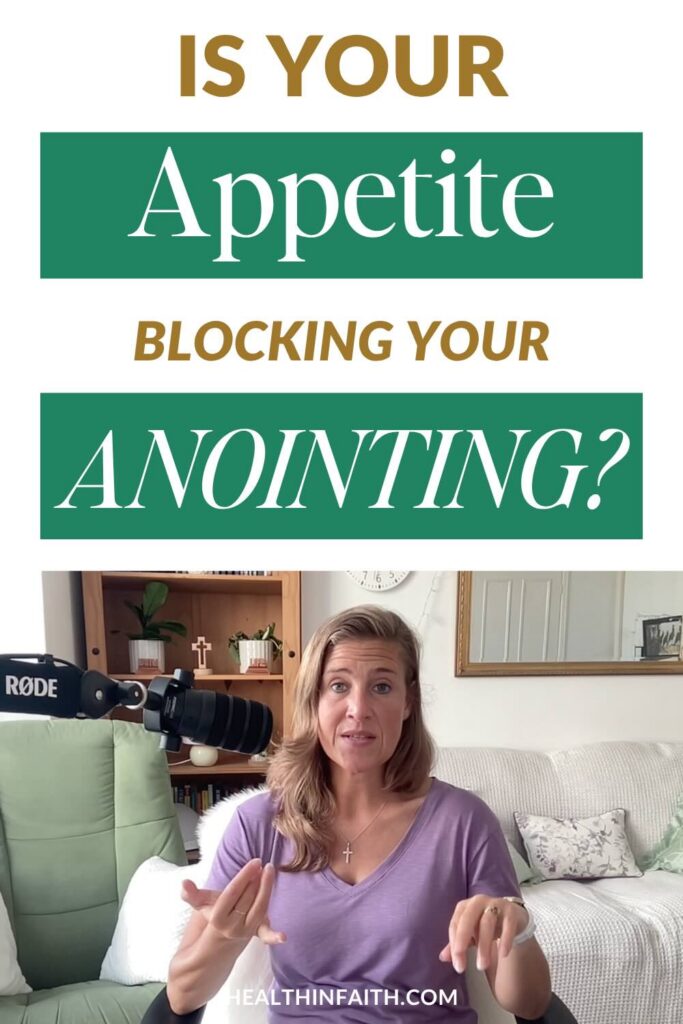
52 | Is Your Appetite Blocking Your Anointing?
Your appetite may be affecting far more than your weight. What you eat, when you eat, how often you eat and whether food has begun to occupy too much mental and emotional space can influence your energy, clarity, confidence and sensitivity to the Lord. This is an important conversation, yet it remains largely unspoken in the Church.
Listen on iTunes | Spotify | Podbean
I am not here to condemn you, accuse you of gluttony or turn food into another heavy religious burden. I want to explore something subtler and, I believe, far more helpful: whether a dysregulated appetite could be quietly dulling your spiritual edge, shrinking your confidence and making it harder to fulfil the work God has placed before you.
Your appetite and weight were never meant to rule your life or shrink your calling. You were created to live with freedom, energy and clarity, nourishing your body well enough to carry the responsibilities, relationships and Kingdom assignments God has entrusted to you.
Why Appetite Has Become a Central Christian Health Issue
I have worked in health and nutrition for almost 25 years, helping people around the world improve their metabolic health, restore their energy and address chronic health problems. Before that, I worked in the NHS managing medical research, but I eventually left because I wanted to see people become genuinely well rather than remain trapped in an endless cycle of symptoms, prescriptions and appointments.
Over the years, I have worked with people affected by cancer, heart disease, diabetes, stroke, memory problems, hormonal imbalances, menopause symptoms and metabolic syndrome. These conditions are not all caused by one thing, of course, and it would be irresponsible to pretend otherwise. Yet when I look for a common thread running through so many health struggles, I repeatedly come back to appetite: what we eat, the quality of what we eat, how much we consume and whether we ever allow the body a genuine break between meals.
We usually think of appetite as a simple physical urge, but it is influenced by blood sugar, stress, sleep, hormones, habits, environment and emotions. It can also become entangled with comfort, avoidance, fear, disappointment and the desire to numb ourselves. That is why merely telling someone to “eat less” rarely solves the underlying problem. A healthy appetite is not produced through shame; it is restored through nourishment, metabolic support, emotional honesty and wiser rhythms.
There is a beautiful comparison with music here. The spaces of silence between the notes are just as important as the notes themselves. Without those spaces, music becomes noise. In a similar way, the periods when we are not eating can be as important as the food on our plates. Digestion needs rest, blood sugar needs time to settle, insulin needs to fall and the body needs opportunities to draw upon stored energy rather than receive a constant stream of incoming food.
This does not mean everyone should follow extreme fasting protocols. It simply means that constant grazing, snacking and eating from morning until night may be disrupting the natural rhythms God designed into the body.
When Food Occupies Too Much of Your Mind
Many of the people I work with are capable, intelligent Christians who deeply love the Lord. Some are pastors, teachers, evangelists, church planters, authors, worship leaders, business owners, carers and grandparents. They know who they are in Christ, yet they quietly admit that food occupies far too much of their mental space.
They tell me, “I think about food all day,” “I cannot stop snacking,” or “I eat breakfast and feel hungry again two hours later.” Others manage well during the day but experience powerful cravings at night. They may genuinely intend to eat differently, yet by the evening their energy and resolve are gone, and they find themselves eating chocolate, crisps, bread, cereal or whatever else offers immediate comfort.
This is not necessarily evidence of weak character. A strong appetite can have powerful biological roots. Meals that are too low in protein or fat, refined carbohydrates that rapidly raise blood sugar, chronic sleep deprivation and prolonged stress can all increase hunger and weaken appetite regulation.
Research supports this. Protein intake has been shown to increase several satiety signals, including GLP-1 and cholecystokinin, while reducing the hunger hormone ghrelin in the short term. Sleep loss can also disrupt leptin and ghrelin, increasing hunger and making appetite harder to manage. In other words, you may be praying for more discipline while your body is crying out for deeper sleep, stable blood sugar and a properly nourishing meal.
We should not use biology as an excuse for every choice we make, but neither should we spiritualise a physiological problem and then feel ashamed when prayer alone does not correct it. Good stewardship involves both prayer and practical wisdom.
My Own Struggle With Appetite
I understand this issue personally. In my twenties, I was running marathons and ultramarathons while following a vegan, very low-protein and low-fat diet. At the time I believed I was doing everything right. I was eating plant-based food, exercising intensely and consuming many of the foods we are told are exceptionally healthy.
Looking back, it is hardly surprising that I was hungry. I was asking an enormous amount of my body while giving it inadequate protein and very little fat. I now understand far more about satiety, metabolic health and the nutrients required to sustain muscle, hormones, brain function and stable energy.
My more subtle struggle with appetite came later. During and after the Covid period, I found myself reaching for food more often when I was not physically hungry. I was still active, walking, sea swimming and running a little, so this did not necessarily show up dramatically in my weight. From the outside, nobody would have looked at me and thought I had a serious food problem.
Yet I knew that food had gained a grip on me that I did not like. It might have been a little chocolate, dried fruit, coconut chips or a healthy protein bar. These were not always obviously “bad” foods, but that was not the real issue. I was eating when my body had not asked for food, and I began to recognise that this habit was dulling something in me.
How Fear and Disappointment Can Feed Appetite
In 2020, I wrote a book called Romans 13 and Covid-19, exploring the Church’s response to Covid restrictions and questioning how readily Christians should follow every measure presented as necessary for safety. The book reached number one for a period in an Amazon church-leadership category, and I was invited to speak at several events.
It was also polarising. Some people strongly supported the message, while others criticised me, questioned my qualifications and accused the work of being harmful. I also had a near-death experience during that broader period, which added another layer of strain.
Although I continued moving forward, I can see now that the pushback affected me. I became more hesitant about speaking boldly, contacting certain people, submitting articles or stepping into further opportunities. Fear of man began creeping in, and I started playing smaller than I knew I was called to play.
Food became part of that process. Instead of making the difficult phone call, writing the challenging article or confronting the person I needed to speak with, it was easier to have a snack. The food gave me a momentary distraction, softened the discomfort and helped me avoid the next courageous step.
Perhaps you recognise this pattern. You know there is a conversation you need to have, a book you need to write, an opportunity you need to pursue or a boundary you need to establish. Yet instead of facing the discomfort, you wander into the kitchen. The food is not really the central problem. It is functioning as a sedative, a delay tactic or a small emotional shelter.
That is one way appetite can begin blocking anointing. It is not that eating chocolate causes the Holy Spirit to leave you. It is that repeatedly using food to avoid conviction, courage or uncomfortable emotions can make you less responsive to the promptings of God.
Is Your Appetite Dulling Your Spiritual Sensitivity?
When we say something unkind, make a judgemental remark or refuse to do something we know the Lord is asking of us, we often feel a subtle dulling afterwards. Our relationship with God is secure in Christ, but our sensitivity can still be affected by patterns of disobedience, avoidance or self-numbing.
Food can become part of this. If every difficult feeling is immediately answered with something sweet, crunchy or comforting, we lose opportunities to sit with discomfort, pray honestly and allow the Lord to show us what is underneath it.
Perhaps the real need is rest. Perhaps you are lonely, disappointed, angry or afraid. Or you feel unseen in your marriage, burdened by ministry, worried about your children or frustrated that your life is not progressing as you expected. Appetite can become the place where all those unspoken emotions gather.
This is why a Christian approach to appetite must go beyond meal plans and calorie targets. We need to ask not only, “What am I eating?” but also, “What am I asking this food to do for me?”
Food can nourish the body, bring people together and be enjoyed with gratitude. It was never designed to become our counsellor, anaesthetic, reward system or hiding place.
Appetite, Metabolic Health and Your Calling
A dysregulated appetite can eventually produce more visible physical consequences. Frequent snacking, refined carbohydrates, inadequate protein, poor sleep and chronic stress can contribute to blood sugar instability and insulin resistance. Over time, this may show up as stubborn belly fat, raised blood pressure, poor triglyceride or HDL levels, fatigue, cravings and difficulty losing weight.
These are among the warning signs associated with metabolic syndrome, a cluster of risk factors that raises the likelihood of cardiovascular disease and type 2 diabetes. The encouraging truth is that metabolic health is responsive. Appetite, blood sugar, energy and body composition can often improve significantly when eating patterns, sleep, stress and movement are addressed consistently.
This matters because your physical condition affects how you fulfil your calling. Brain fog does not help you write, teach, pray, preach or make wise decisions. Constant cravings interrupt concentration. Poor sleep weakens patience and emotional resilience. Excess weight and aching joints may restrict your willingness to travel, serve, play with grandchildren or take on new responsibilities.
This is not about earning God’s approval through thinness. It is about removing avoidable physical barriers so that your body supports rather than continually drains the work you are called to do.
Appetite and GLP-1 Weight-Loss Medication
We are now living in an era when GLP-1 medications such as semaglutide are widely discussed as solutions for appetite and weight loss. These medications may be clinically appropriate for some people under qualified medical care, particularly where obesity or diabetes creates serious health risks. Any decision to start, continue or stop prescribed medication should be made with the prescribing clinician.
Yet medication does not remove the need to understand why appetite became dysregulated in the first place. GLP-1 is not an artificial concept invented by pharmaceutical companies; it is a hormone naturally released by the gut after eating. It contributes to blood sugar control, slows gastric emptying and helps regulate appetite and food intake.
Diet composition can influence the body’s natural satiety responses, and protein appears especially relevant to several appetite-regulating hormones. Sleep, movement, stress and meal timing also influence hunger and eating behaviour. This means there is real value in learning how to support appetite naturally, whether or not medication is part of someone’s current treatment.
The aim should not merely be to silence hunger by force. It should be to rebuild a body that can recognise genuine hunger, experience satisfaction from nourishing food and comfortably stop eating when enough has been consumed.
Blog Bonus: The Appetite Audit
Here is a practical exercise I did not cover fully in the podcast. For the next seven days, complete a simple appetite audit. Do not use it to criticise yourself or attempt perfection. Use it to uncover patterns with honesty and curiosity.
Before eating, pause for a few seconds and rate your physical hunger from zero to ten. Zero means no physical hunger at all, while ten means ravenously hungry, shaky or unable to concentrate. Then ask yourself three questions:
- Where do I feel this hunger? Genuine physical hunger is usually felt in the body. Emotional appetite often begins in the mind as a desire for a specific taste, texture or sensation.
- What happened immediately before I wanted food? Were you working, worrying, scrolling, arguing, feeling rejected or avoiding a task? This helps reveal the trigger underneath the appetite.
- What does my body genuinely need right now? The answer may be a balanced meal, but it may also be water, rest, prayer, fresh air, comfort, movement or a difficult conversation.
After eating, wait for around 15 minutes before deciding whether you need more. The purpose is not to obey a rigid fullness rule but to create enough space for your body’s satiety signals to register. Eat without rushing where possible, chew well and pay attention to the point at which the meal stops tasting quite as compelling. That subtle shift is often one of the body’s early signs of satisfaction.
At the end of the week, look for patterns rather than isolated incidents. Perhaps you are under-eating protein at breakfast and then craving sugar by late morning. Maybe you eat well all day but use food as a reward after work. You may discover that poor sleep sharply increases your appetite the next day, or that certain ministry responsibilities leave you resentful and reaching for comfort.
The goal is not merely appetite control. It is appetite understanding. Once you see what your eating is communicating, you can begin meeting the real need more wisely.
Rebuilding the Walls Around Your Appetite
Proverbs describes a person without self-control as a city with broken-down walls. That is a vivid picture of vulnerability. Without healthy boundaries, anything can enter, take over and drain the resources of the city.
If your eating has become unstructured, reactive or emotionally driven, do not condemn yourself. Think of Nehemiah rebuilding Jerusalem’s walls: patiently, section by section, with prayer, vigilance and practical work.
Your first rebuilt section might be eating a protein-rich breakfast. It might be closing the kitchen after dinner, creating three clear meals, removing one trigger food from the house or praying for five minutes before your most vulnerable eating window. One repaired section creates stability for the next.
This is how appetite is redeemed. Not through shame, but through truth, nourishment, structure and spiritual attentiveness.
A New Season of Health in Faith
I believe the Lord has significant work for His people to do in this season. That requires sensitivity in the spirit, clarity in the mind and enough physical energy to follow through when He speaks.
You may have a book to write, a ministry to build, grandchildren to influence, a marriage to strengthen, a church to serve or a message that needs to be heard. Food should nourish that calling, not quietly shrink it.
Perhaps this can become your Christian glow-up season—not in a vain or worldly sense, but as a season of becoming healthier, brighter, freer and more fully alive. There is nothing ungodly about wanting clear eyes, healthy hair, a strong body, better sleep and greater confidence. God created beauty, and He created your body to be cared for rather than neglected.
The deeper goal, however, is freedom. Freedom from thinking about food all day. Freedom from the shame-and-restriction cycle. Freedom from needing another snack to face an uncomfortable feeling. Freedom to hear the Lord clearly and have the energy to respond.
Your appetite does not have to block your anointing. With the right physical nourishment, metabolic support, emotional honesty and biblical wisdom, it can take its proper place again: serving your body rather than ruling your life.
What to Do Next
If this is stirring something in you, don’t ignore that prompt. This is not about playing smaller, hiding behind food or accepting that cravings will control you forever. It is time to rebuild the walls, redeem your appetite and step into the work God has placed before you.
Your appetite should not be consuming the energy, clarity and focus you need for the work God has called you to do. Health for Life —my 12 week coaching program for Christians, helps you address the deeper foundations of cravings, overeating, food noise and metabolic imbalance so you can stop fighting food and start rebuilding your health with wisdom.
Whilst your anointing is not earned through weight loss, and your calling is not cancelled by a health struggle; chronic fatigue, unstable appetite and poor metabolic health can make it harder to show up with the strength, confidence and stamina your assignment requires. Inside Health for Life, I guide you through a clear, faith-rooted framework to regulate appetite, rebuild your metabolism, restore your energy and bring the major areas of your health into alignment.
This is not another restrictive diet or temporary burst of motivation. It is a practical path towards becoming lighter, stronger and better fuelled for the life and Kingdom work God has placed before you. Come and join us in Health for Life and begin stewarding your health in a way that supports your calling rather than competes with it. Reach out if you have any questions.
References
Kohanmoo A, Faghih S, Akhlaghi M. Effect of short- and long-term protein consumption on appetite and appetite-regulating gastrointestinal hormones: a systematic review and meta-analysis of randomised controlled trials. Physiology & Behavior. 2020;226:113123.
Spiegel K, Tasali E, Penev P, Van Cauter E. Brief communication: sleep curtailment in healthy young men is associated with decreased leptin levels, elevated ghrelin levels and increased hunger and appetite. Annals of Internal Medicine. 2004;141(11):846–850.
Bodnaruc AM, Prud’homme D, Blanchet R, Giroux I. Nutritional modulation of endogenous glucagon-like peptide-1 secretion: a review. Nutrition & Metabolism. 2016;13:92.
Drucker DJ. Mechanisms of action and therapeutic application of glucagon-like peptide-1. Cell Metabolism. 2018;27(4):740–756.


TUNE IN NOW
Listen to the Health in Faith Podcast